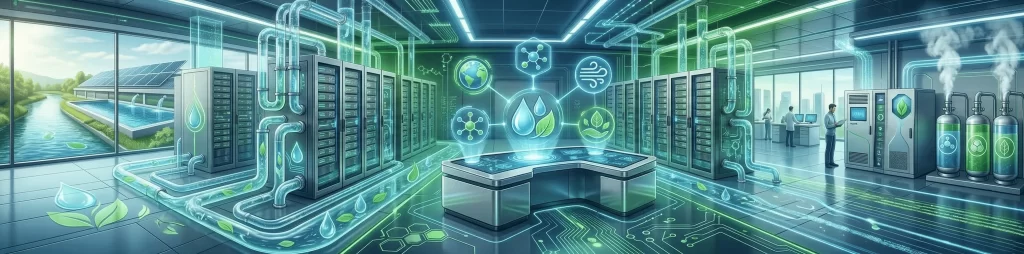
The data center industry has long treated Power Usage Effectiveness as its north-star sustainability metric. But as AI-driven rack densities surge past 100 kW and liquid cooling becomes the default, two environmental costs — water consumption and refrigerant emissions — are escaping the ledger. It is time to account for them.
Why PUE Alone No Longer Tells the Full Story
Power Usage Effectiveness (PUE) has served the data center industry well since The Green Grid introduced it in 2007. Google reports a fleet-wide average annual PUE of 1.09 in 2024, far below the industry average of 1.56. Those numbers signal impressive electrical efficiency — but they say nothing about the thousands of liters of water evaporated every hour, or the tonnes of high-GWP refrigerants circulating through chiller plants.
PUE measures a ratio of total facility energy to IT equipment energy. It captures electricity, not ecology. As operators chase ever-lower PUE figures, many have adopted evaporative cooling strategies that trade kilowatt-hours for water. The result is a lopsided sustainability story: a data center can achieve a PUE of 1.1 while consuming millions of gallons of freshwater per year.
The shift to liquid cooling — driven by AI accelerators that dissipate 700 W to 1,200 W per chip — compounds the challenge. Direct-to-chip cold plates and single-phase immersion systems deliver superior thermal performance, but they introduce closed-loop or open-loop water circuits that must be monitored, treated, and eventually disposed of. Two-phase immersion cooling, meanwhile, relies on engineered fluids that may contain PFAS (per- and polyfluoroalkyl substances), chemicals now under regulatory scrutiny in both the EU and the United States.
Green computing, in short, is moving from a single-metric era into a full-stack environmental accounting era. PUE is necessary but insufficient. Operators, investors, and regulators now need a dashboard that includes WUE (Water Usage Effectiveness), CUE (Carbon Usage Effectiveness), refrigerant GWP budgets, embodied carbon, and end-of-life recyclability.
Water Usage Effectiveness: The Metric That Deserves Equal Billing
What Is WUE and Why Does It Matter?
Water Usage Effectiveness (WUE) was introduced by The Green Grid in 2011. It is calculated as:
WUE = Annual Site Water Usage (liters) ÷ IT Equipment Energy (kWh)
The industry average WUE hovers around 1.8 L/kWh. High-performing green data centers can achieve values of 0.2 L/kWh or lower — less than one cup of water per kilowatt-hour of IT energy.
But WUE has blind spots. It does not differentiate between potable water and reclaimed or recycled sources. It also ignores embedded water — the water consumed upstream in power generation. A data center running on coal-fired electricity may have a low on-site WUE but a massive indirect water footprint.
How Much Water Do Data Centers Actually Use?
The numbers are staggering. U.S. data centers directly consumed an estimated 66 billion liters of water in 2023, up from 21.2 billion liters in 2014. A medium-sized facility can consume roughly 110 million gallons per year for cooling — equivalent to the annual water usage of approximately 1,000 households.
Large hyperscale campuses can consume up to 5 million gallons per day, rivaling the water use of a town of 10,000 to 50,000 people. Training OpenAI’s GPT-3 model in Microsoft’s U.S. data centers directly evaporated an estimated 700,000 liters of clean freshwater.
The Liquid Cooling Paradox
Liquid cooling is marketed as a sustainability solution — and in many respects it is. A 2024 Microsoft-funded study published in Nature found that cold-plate and immersion cooling technologies reduce greenhouse gas emissions 15–21%, energy demand 15–20%, and water consumption 31–52% over their entire life cycles compared with traditional air cooling.
Yet liquid cooling is not inherently water-free. Direct-to-chip cold plates circulate water or water-glycol mixtures through server-level heat exchangers. That water must be treated to prevent corrosion and biological growth, and it must be periodically replaced. Facility-level heat rejection still often relies on cooling towers, which evaporate water.
Microsoft announced in August 2024 a zero-water-for-cooling datacenter design that uses chip-level cooling in a closed-loop system, avoiding evaporative cooling entirely. The design is projected to save more than 125 million liters of water per year per datacenter. This represents a best-in-class benchmark, but it is not yet the industry norm.
The takeaway: liquid cooling can dramatically reduce water consumption, but only if the entire thermal chain — from chip to atmosphere — is designed with water stewardship in mind.
Refrigerants: The Hidden Carbon Bomb in Your Chiller Plant
Why Refrigerants Matter for Data Center Carbon Accounting
Traditional data center cooling relies on vapor-compression chillers charged with hydrofluorocarbon (HFC) refrigerants. These substances are potent greenhouse gases. R-410A, one of the most common data center refrigerants, has a Global Warming Potential (GWP) of 2,088 — meaning one kilogram of R-410A released into the atmosphere has the same warming effect as 2,088 kilograms of CO₂.
Refrigerant leakage is not hypothetical. Industry estimates suggest that commercial HVAC systems lose 2–10% of their refrigerant charge annually through micro-leaks, maintenance events, and end-of-life disposal. For a large chiller plant holding hundreds of kilograms of R-410A, even a modest leak rate translates to significant Scope 1 greenhouse gas emissions.
The EU F-Gas Regulation: A Regulatory Earthquake
The European Union’s revised F-Gas Regulation (EU) 2024/573, which took effect on March 11, 2024, represents the most aggressive regulatory action on refrigerants to date. Key milestones include:
- January 1, 2025: Sale of single split systems containing fluorinated gases with GWP ≥ 750 (and less than 3 kg charge) is prohibited.
- January 1, 2032: Newly produced refrigerants with GWP ≥ 750 cannot be used for maintenance of existing stationary refrigeration systems (except chillers).
- 2050: Total ban on HFC use.
The regulation forces data center operators to plan refrigerant transitions decades in advance. Equipment purchased today must be evaluated not just for first-cost and efficiency, but for long-term refrigerant availability and regulatory compliance.
Low-GWP Alternatives and the Halogen-Free Movement
The industry is pivoting toward low-GWP refrigerants:
- R-513A (GWP 631): A near-drop-in replacement for R-134a, widely adopted in centrifugal chillers.
- R-454B (GWP 466): Positioned as a replacement for R-410A in DX systems.
- R-1234yf (GWP 4) and R-1234ze (GWP 7): Ultra-low-GWP hydrofluoroolefins (HFOs) gaining traction in new chiller designs.
- R-744 (CO₂) and R-717 (ammonia): Natural refrigerants with GWPs of 1 and 0 respectively, increasingly explored for large-scale cooling.
Germany’s Blue Angel ecolabel for data centers (DE-UZ 228) goes further, requiring that cooling systems commissioned after January 1, 2013 use only halogen-free refrigerants. This means no HFCs, no HFOs — only natural refrigerants like CO₂, ammonia, or hydrocarbons. While voluntary, the Blue Angel standard signals the direction of travel for the most environmentally ambitious operators.
PFAS in Immersion Cooling: A Regulatory Wild Card
Two-phase immersion cooling, which submerges servers in a dielectric fluid that boils at low temperatures, offers exceptional thermal performance. However, many of the engineered fluids used in these systems — such as fluorinated ketones and hydrofluoroethers — fall under the broad definition of PFAS (“forever chemicals”).
The EU’s proposed PFAS restriction, if adopted in its broadest form, could ban or severely restrict these fluids. Microsoft has noted that while two-phase immersion cooling shows promise for reducing energy and water use, PFAS concerns are “at odds with pollution-reduction goals and possibly making them unavailable in the future.” The company has investigated but is not currently deploying immersion cooling in production datacenters.
For operators evaluating immersion cooling today, fluid chemistry due diligence is essential. Selecting a fluid with a clear regulatory pathway — or investing in non-fluorinated alternatives — is a strategic imperative.
Carbon Emissions: From Scope 2 Tunnel Vision to Full Life-Cycle Accounting
Operational Carbon vs. Embodied Carbon
Data center carbon accounting has historically focused on Scope 2 emissions — indirect emissions from purchased electricity. This makes sense: energy consumption dominates the operational footprint. But as grids decarbonize and renewable energy procurement becomes standard, Scope 3 emissions — particularly embodied carbon in construction materials and equipment — are becoming a larger share of the total.
A Bloomberg report in January 2026 highlighted that the U.S. data center buildout has a “hidden source of carbon emissions”: the immense amount of carbon-intensive concrete required to build these facilities. Tech companies are increasingly purchasing low-carbon concrete, but the industry lacks standardized methods for quantifying and comparing embodied carbon across projects.
Schneider Electric research suggests that over 80% of a typical company’s emissions are Scope 3. For data centers, the proportion varies depending on grid carbon intensity, but Scope 3 categories — including embodied carbon in servers, cooling equipment, and building materials — are consistently underreported.
The Role of Life-Cycle Assessment (LCA)
Life-Cycle Assessment provides a framework for evaluating environmental impacts from “cradle to grave.” The iMasons Climate Accord has published best practices for data center LCAs, emphasizing that assessments should cover:
- Material extraction and manufacturing (embodied carbon in steel, concrete, copper, and rare earth elements)
- Transportation (shipping equipment globally)
- Construction (on-site energy and waste)
- Use phase (operational energy, water, and refrigerant emissions)
- End-of-life (decommissioning, recycling, and disposal)
Microsoft’s 2024 Nature study is notable for quantifying cooling technology impacts across the full life cycle — not just the use phase. This kind of holistic analysis is essential for making informed technology choices.
Recyclability and E-Waste: Closing the Loop on Data Center Hardware
The Growing E-Waste Challenge
As of 2023, U.S. data center energy use neared 176 terawatt-hours, accounting for close to 4.4% of national energy consumption — a figure expected to reach 12% within three years. The rapid hardware refresh cycles driven by AI workloads mean that servers, GPUs, and networking equipment are being retired faster than ever.
Data center e-waste includes circuit boards containing precious metals, lithium batteries, and cooling fluids that may be hazardous. The EU’s Waste Electrical and Electronic Equipment (WEEE) Directive mandates collection, recycling, and recovery targets for enterprise-grade equipment.
Designing for Circularity
Leading operators are adopting circular economy principles:
- Modular server designs that allow component-level replacement rather than full-unit disposal
- Closed-loop coolant recycling for liquid cooling systems
- Refrigerant reclamation programs that capture, purify, and reuse HFCs rather than venting them
- Partnerships with certified e-waste recyclers that meet R2 or e-Stewards standards
The goal is to minimize the volume of materials entering landfills and maximize the recovery of valuable resources — copper, gold, palladium, and rare earth elements — from retired equipment.
ESG Reporting: How Investors Are Raising the Bar
Environmental, Social, and Governance (ESG) frameworks are increasingly shaping data center investment decisions. GRESB, the leading ESG benchmark for real assets, now evaluates data centers on both operational and embodied carbon. The EU’s Corporate Sustainability Reporting Directive (CSRD), which began phased implementation in 2024, requires large companies to disclose detailed environmental data — including water consumption, refrigerant emissions, and waste management practices.
For data center operators, this means:
- WUE and water source disclosure will become as routine as PUE reporting.
- Refrigerant inventories and leak rates must be tracked as Scope 1 emissions.
- Embodied carbon in construction will need to be quantified and reported.
- E-waste recycling rates will be scrutinized by investors and regulators alike.
The operators who proactively adopt multi-metric sustainability frameworks will be better positioned to attract capital, secure permits, and win enterprise customers who face their own ESG disclosure obligations.
What Should Data Center Operators Do Now?
A Five-Point Action Plan
- Adopt multi-metric sustainability dashboards. Track PUE, WUE, CUE, and refrigerant GWP budgets as co-equal indicators. No single metric captures the full environmental footprint.
- Audit your refrigerant inventory. Identify high-GWP substances, assess leak rates, and develop transition plans aligned with the EU F-Gas Regulation timeline — even if you operate outside the EU, because global supply chains will be affected.
- Design liquid cooling systems for water stewardship. Specify closed-loop heat rejection where possible. When evaporative cooling is used, prioritize reclaimed or non-potable water sources and report water consumption transparently.
- Demand life-cycle data from suppliers. Request Environmental Product Declarations (EPDs) for servers, cooling equipment, and construction materials. Integrate embodied carbon into procurement decisions.
- Prepare for PFAS regulation. If evaluating immersion cooling, conduct thorough due diligence on fluid chemistry. Favor non-fluorinated or low-regulatory-risk fluids where performance requirements allow.
The Bottom Line
The era of PUE-as-proxy-for-green is ending. The next generation of sustainable data centers will be measured on a full-stack environmental scorecard — one that accounts for every liter of water evaporated, every gram of refrigerant leaked, every tonne of embodied carbon poured, and every kilogram of e-waste recycled.
For operators, this shift is both a challenge and an opportunity. Those who move early to adopt holistic sustainability metrics will not only reduce their environmental impact — they will build competitive advantages in an industry where ESG performance is rapidly becoming a prerequisite for doing business.
The question is no longer “What is your PUE?” The question is “What is the true environmental cost of your compute?”
发表回复
要发表评论,您必须先登录。