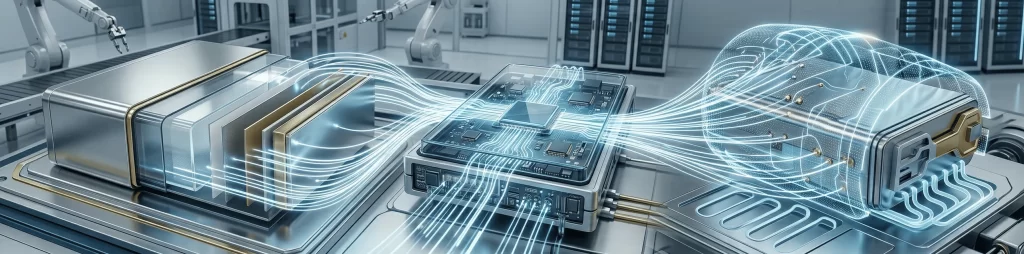
Shifting battery chemistries are set to reshape power management, safety architectures, and cell-balancing strategies across consumer electronics and electric vehicles. Here is what engineers and product designers need to know right now.
Why Solid-State Batteries Matter in 2026
The lithium-ion battery has dominated portable electronics and electric vehicles (EVs) for over three decades. Yet its liquid electrolyte introduces inherent trade-offs: thermal runaway risk, limited energy density ceilings, and charging-speed constraints imposed by dendrite growth. Solid-state batteries (SSBs) replace that flammable liquid with a solid electrolyte — ceramic, sulfide, or polymer — unlocking a fundamentally different performance envelope.
In practical terms, solid-state cells promise:
- Energy density above 400 Wh/kg (versus ~250 Wh/kg for today’s best NMC pouch cells)
- Intrinsic non-flammability, eliminating the primary trigger for thermal runaway
- Faster charging enabled by suppressed dendrite formation at the anode
- Wider operating temperature windows, from –40 °C to well above 60 °C
These advantages do not merely improve a spec sheet. They fundamentally alter the requirements placed on Battery Management Systems (BMS), fast-charging protocols, safety certification (regulatory compliance), and cell-balancing topologies — the very infrastructure that keeps batteries safe and efficient.
Where Does Solid-State Commercialization Stand Today?
Semi-Solid: Already Shipping
Semi-solid-state batteries — hybrids that replace most, but not all, liquid electrolyte with solid materials — are already in limited commercial production. Chinese manufacturers such as Qingtao Energy have connected 200 MW / 800 MWh semi-solid energy storage systems to the grid, claiming a cycle life of 12,000 cycles. In the EV space, NIO and other Chinese OEMs have deployed semi-solid packs in flagship sedans since late 2024.
All-Solid-State: Pilot Lines and Qualification
True all-solid-state batteries (ASSBs) with zero liquid electrolyte remain in the pilot-production and qualification phase, but progress has accelerated sharply:
- ION Storage Systems (USA) announced in March 2026 that a customer has successfully qualified its Cornerstone Cell — making it the first US solid-state technology company to achieve cell-performance qualification for industrial, consumer-electronics, and automotive applications.
- Toyota received production approval for its all-solid-state battery in Japan in late 2025. Mass production is targeted for 2027, with first deployment in Lexus flagship models promising a 1,200 km range after just 10 minutes of charging.
- Samsung SDI, BMW, and Solid Power signed a trilateral agreement in October 2025 to collaborate on ASSB validation, with Samsung SDI targeting mass production around 2027.
- QuantumScape and Volkswagen’s PowerCo demonstrated solid-state cells in a Ducati electric motorcycle at IAA Mobility 2025, achieving 10–80 % charge in 12 minutes.
- Changan Automobile plans trial installations of its “Golden Bell” all-solid-state battery (400 Wh/kg, >1,500 km CLTC range) before Q3 2026.
- Chery unveiled a 600 Wh/kg all-solid-state cell at its “Battery Night” event in March 2026, with vehicle testing slated for 2027.
Global solid-state battery penetration is estimated at roughly 0.1 % in 2026. The automotive solid-state battery market was valued at USD 1.77 billion in 2025 and is projected to reach USD 31.1 billion by 2034, growing at a CAGR of 51.2 %.
How Do Solid-State Batteries Change BMS Design?
A Battery Management System is the brain of any battery pack. It monitors voltage, current, and temperature; estimates state of charge (SOC) and state of health (SOH); manages cell balancing; and enforces safety cut-offs. When the underlying cell chemistry changes as dramatically as the shift from liquid to solid electrolyte, BMS hardware and firmware must evolve in parallel.
Different Voltage Profiles and SOC Estimation
Solid-state cells — especially those using a lithium-metal anode — exhibit voltage-versus-SOC curves that differ from conventional graphite-anode cells. The flatter voltage plateau of lithium metal makes traditional voltage-based SOC estimation less accurate. BMS algorithms will need to rely more heavily on coulomb counting with adaptive Kalman filtering or impedance-based methods to maintain precision.
New Failure Modes Require New Diagnostics
Liquid-electrolyte cells fail through well-characterized mechanisms: gas generation, separator melting, electrolyte decomposition. Solid-state cells introduce different failure modes, including interfacial delamination between the solid electrolyte and electrode, micro-crack propagation in ceramic electrolytes under mechanical stress, and localized lithium filament growth at grain boundaries. A next-generation BMS must incorporate diagnostic routines — such as electrochemical impedance spectroscopy (EIS) at the pack level — capable of detecting these degradation signatures before they become safety events.
Simplified Thermal Management
Because solid electrolytes are non-flammable and SSBs tolerate a wider temperature range, the thermal management subsystem can be significantly simplified. Liquid cooling loops may shrink or be replaced by passive heat-spreading solutions. The BMS thermal-control logic — which today aggressively curtails charge and discharge rates when temperatures approach safety thresholds — can be relaxed, improving usable performance in extreme climates.
What Does Solid-State Mean for Fast Charging?
Fast charging in conventional lithium-ion cells is limited primarily by the risk of lithium plating on the graphite anode. When charging current is too high, lithium ions deposit as metallic lithium on the anode surface instead of intercalating between graphite layers, forming dendrites that can pierce the separator and cause an internal short circuit.
Solid-state batteries address this bottleneck in two ways:
- Lithium-metal anodes welcome plating by design. In an SSB with a lithium-metal anode, the charge mechanism is lithium plating — but onto a controlled metallic surface rather than onto graphite. The solid electrolyte mechanically suppresses dendritic penetration.
- Higher thermal tolerance. Fast charging generates significant heat. Solid electrolytes withstand higher temperatures without the decomposition risk of organic liquid solvents, enabling higher sustained charge currents.
Toyota’s solid-state roadmap targets a 10-minute charge to 80 % — a rate that would require roughly 4–6C sustained charging and is impractical with today’s liquid-electrolyte cells at scale without severe cycle-life degradation.
For BMS designers, this means fast-charging algorithms can operate in a significantly wider current-voltage-temperature envelope, but the control logic must still account for solid-electrolyte interface (SEI) resistance changes, stack pressure management (critical in sulfide-based SSBs), and contact-loss detection at the electrode–electrolyte interface.
How Will Safety Standards and Regulatory Compliance Evolve?
Current Certification Landscape
Today’s battery safety standards — IEC 62133 for portable cells, UN 38.3 for transport, UL 2054 / UL 2580 for consumer and EV batteries, GB 38031 in China — are built around the failure characteristics of liquid-electrolyte lithium-ion cells. Test protocols focus on thermal runaway propagation, nail penetration, overcharge-induced gas venting, and external short-circuit behavior.
What Changes with Solid-State?
Solid-state cells exhibit fundamentally different abuse-response behavior:
- No flammable electrolyte leakage during penetration or crush
- Reduced or absent gas generation during overcharge
- Higher short-circuit resistance due to the mechanical rigidity of ceramic or sulfide electrolytes
This does not mean SSBs are exempt from certification — far from it. China is set to release its first national standard for solid-state batteries in July 2026, which will define terminology, classification, and test methods specifically for SSBs. International standards bodies (IEC, SAE, ISO) are expected to follow.
For BMS and pack-level designers, the transition period will require dual compliance: meeting existing lithium-ion safety standards while preparing for new SSB-specific requirements. Safety ICs, fuse ratings, and contactor specifications may all need revision as the abuse-response envelope shifts.
Cell Balancing in a Solid-State World: What Changes?
Cell balancing is essential whenever cells are connected in series — and it remains essential for solid-state packs. However, the balancing challenge evolves.
Why Balancing Is Still Necessary
Even in a pack of identical solid-state cells, manufacturing tolerances, temperature gradients across the pack, and differences in aging rates create SOC divergence over time. Without balancing, the weakest cell limits the usable capacity of the entire pack.
Passive vs. Active Balancing for SSBs
Passive balancing — dissipating excess energy from higher-SOC cells as heat through shunt resistors — is the dominant approach in today’s consumer-electronics and many automotive packs due to its simplicity and low cost.
Active balancing — transferring charge from higher-SOC cells to lower-SOC cells using capacitors, inductors, or DC-DC converters — recovers energy instead of wasting it, improving pack-level efficiency.
Solid-state batteries tip the calculus toward active balancing for several reasons:
- Higher cell cost. Early SSBs will carry a price premium. Maximizing every cell’s usable capacity has a direct impact on pack-level cost per kWh.
- Flatter voltage curves. Lithium-metal anode cells have flatter discharge profiles, meaning voltage differences between cells at different SOCs are smaller — requiring more sensitive and responsive balancing hardware.
- Longer cycle life. SSBs are expected to deliver superior cycle life (some semi-solid systems already claim 12,000+ cycles). Over that extended life, cumulative imbalance grows, making robust active balancing even more important.
For BMS IC manufacturers such as Texas Instruments, Analog Devices, NXP, and Renesas, this signals a growing market for high-accuracy active-balancing front-end ICs with sub-millivolt measurement resolution.
Implications for Consumer Electronics
While the automotive sector captures most headlines, solid-state batteries may actually reach consumer electronics at scale sooner. Smaller cell formats, lower absolute energy requirements, and higher tolerance for premium pricing make wearables, smartphones, medical devices, and drones attractive early-adoption segments.
What Changes for CE Product Designers?
- Thinner, lighter form factors. Higher volumetric energy density means a solid-state cell delivering the same capacity as today’s lithium-polymer pouch cell can be 30–50 % thinner.
- Simplified safety architecture. Without flammable electrolyte, protection circuits (PTC devices, CIDs, vent structures) can be downsized or eliminated, freeing board space.
- Faster charging without throttling. A smartwatch or earbud that charges fully in under 5 minutes — without the BMS aggressively throttling current to prevent overheating — becomes feasible.
- Extended operational temperature range. Outdoor IoT sensors and industrial wearables can operate reliably in sub-zero or high-heat environments without bulky thermal insulation.
ION Storage Systems’ successful qualification of its Cornerstone Cell for consumer-electronics customers in early 2026 signals that this transition is no longer hypothetical.
The Road Ahead: A Timeline for Engineers
| Timeframe | Milestone |
|---|---|
| 2026 H1 | China releases first national SSB standard; ION Storage Systems cells qualified |
| 2026 H2 | Changan begins trial SSB installations in vehicles; semi-solid ESS deployments scale |
| 2027 | Toyota launches first ASSB-powered Lexus EV; Samsung SDI targets ASSB mass production |
| 2027–2028 | QuantumScape / PowerCo scale automotive-grade SSB production lines |
| 2028–2030 | SSB penetration in premium EVs reaches meaningful volume; consumer-electronics adoption widens |
| 2030+ | Cost parity with liquid-electrolyte cells anticipated; mainstream adoption begins |
Key Takeaways for BMS and Power-Management Engineers
- Redesign SOC/SOH algorithms for lithium-metal anode voltage profiles and new impedance signatures.
- Prepare for new failure modes — interfacial delamination and micro-crack propagation demand new diagnostic firmware.
- Simplify thermal management hardware, but add stack-pressure monitoring for sulfide-based packs.
- Shift toward active cell balancing to maximize the value of premium SSB cells over their extended cycle life.
- Track evolving safety standards — dual compliance with existing Li-ion and emerging SSB-specific regulations will be required during the transition period.
- Leverage faster charging envelopes in BMS charge-control logic, but implement new interface-resistance and contact-loss monitoring.
Solid-state battery commercialization is no longer a question of if — it is a question of how fast. For engineers working in BMS design, power management, fast-charging infrastructure, and safety certification, the time to start adapting architectures is now.
发表回复
要发表评论,您必须先登录。