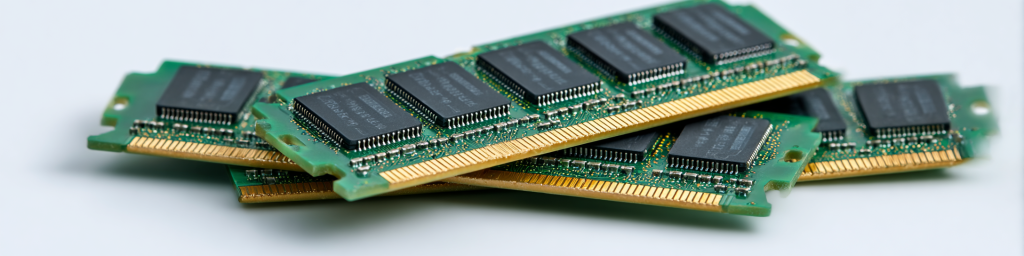
The “Memory Supercycle” has arrived, but for the average PC enthusiast or procurement manager, it feels less like a boom and more like a blockade. As 2025 draws to a close, a distinct and painful economic phenomenon is reshaping the semiconductor landscape: Price Spillover. The insatiable appetite of AI servers for HBM3E (High Bandwidth Memory) and high-density server DDR5 is cannibalizing the wafer supply meant for consumer PCs, driving up costs and extending lead times for standard DDR5 modules.
This deep dive analyzes the structural mechanics behind this price surge, backed by data from TrendForce and supply chain signals, to explain why the “Server Squeeze” is raising the bill for your next laptop or desktop build.
1. The Core Mechanism: The “Wafer Eater” Effect of HBM3E 12-Hi
To understand why PC memory is becoming expensive, we must look at the manufacturing floor. The root cause is not a failure of demand forecasting, but a physics-driven constraint in wafer allocation.
1.1 The Die Penalty of 12-Hi Stacks
The industry is aggressively transitioning from HBM3 (8-Hi) to HBM3E (12-Hi) to meet the memory bandwidth requirements of NVIDIA’s Blackwell and AMD’s MI325 architectures.
- Wafer Consumption: Producing a 12-Hi HBM stack consumes significantly more wafer area than producing standard DDR5 DRAM. Industry estimates suggest that for every 1 bit of HBM produced, manufacturers must sacrifice the capacity to produce 3 to 4 bits of standard DDR5.
- Yield Attrition: The manufacturing complexity of 12-Hi stacks—involving extreme wafer thinning (down to 30 microns), hybrid bonding, and thousands of TSV (Through-Silicon Via) connections—results in lower yield rates. Lower yields mean more wafers must be processed to get the same number of “good dies,” effectively removing those wafers from the pool available for standard PC DRAM.
1.2 The Capacity Shift: Samsung, SK Hynix, and Micron
The “Big Three” memory makers are rational economic actors. With HBM commanding margins of 50-60% versus the historically thin margins of commodity DRAM, they are reallocating their most advanced production lines (1alpha, 1beta nodes) to HBM.
- Samsung: Reportedly shifting significant capacity from its Pyeongtaek lines—originally slated for DDR5—to HBM3E to catch up with SK Hynix.
- SK Hynix: As the HBM market leader, their capacity is almost entirely booked by NVIDIA, leaving minimal room for spot market DDR5 production adjustments.
- Micron: Aggressively ramping 1beta HBM3E, explicitly stating in earnings calls that “bit supply growth” for standard DRAM will be constrained by this shift.
2. The Spillover: How Server Panic Buys Inflate PC BOMs
The “Spillover” effect occurs when the scarcity in the primary market (AI Servers) forces buyers to pay premiums that ripple into secondary markets (Consumer PC).
2.1 TrendForce Forecasts: The “Upward Revision” Reality
TrendForce has consistently revised its pricing outlooks upward throughout Q4 2025.
- Contract Prices: Originally forecast to rise by 8-13%, expectations for Q1 2026 have shifted to a 15-25% increase for server DRAM.
- The Linkage: PC OEMs (Dell, HP, Lenovo) compete for the same raw DRAM dies as Server ODMs (Foxconn, Quanta). When server contract prices rise, DRAM manufacturers have zero incentive to sell dies to the PC market at a lower price. Consequently, PC DDR5 contract prices are dragged upward, “spilling over” from the server hike.
2.2 Server RDIMM vs. PC UDIMM: The Profitability Gap
Server memory (RDIMM/LRDIMM) uses the same core DDR5 silicon as PC memory (UDIMM/SODIMM) but adds features like ECC and buffers.
- Allocation Priority: In a shortage, fabs prioritize Server RDIMMs because Hyperscalers (AWS, Google, Microsoft) buy in massive volumes with long-term agreements (LTAs) and less price sensitivity.
- The Leftovers: The PC market is effectively fighting for the “leftover” capacity. As Hyperscalers expand their AI training clusters, the pool of leftovers shrinks, driving up the spot price for consumer modules.
3. Market Data Analysis: Spot vs. Contract Price Divergence
The current market is characterized by a violent divergence between Spot and Contract prices, a classic signal of a “Seller’s Market.”
3.1 Spot Market Volatility
Spot prices—the price distributors pay for immediate delivery—act as the “canary in the coal mine.”
- The Surge: Since September 2025, spot prices for mainstream DDR5 16Gb dies have surged significantly. Reports indicate a double-digit percentage rise week-over-week in December.
- Premium Expansion: The “Spot Premium” (the difference between spot and contract price) has widened. This forces module houses (Kingston, ADATA, Corsair) to pay more to secure chips, costs which are immediately passed on to consumers.
3.2 Lead Times: From “Just-in-Time” to “Wait-in-Line”
Lead times for high-density DDR5 modules have extended from the standard 8-10 weeks to 20+ weeks.
- Inventory Levels: Distributor inventory for DDR5 is running lean. The “Days of Inventory” (DOI) metric has dropped below the 4-week safety stock level for many high-speed SKUs (6000MT/s+), exacerbating panic buying.
4. 2026 Outlook: Will the “Supercycle” Break?
Is this a temporary blip or the new normal?
- The “Bullwhip Effect”: History warns of the bullwhip effect, where panic buying leads to over-ordering and an eventual crash. However, the structural nature of the AI demand suggests this cycle is different.
- Supply Constraint Persistence: Unlike previous crypto-mining bubbles, AI training demand is backed by massive, multi-year CAPEX plans from trillion-dollar companies.
- Conclusion: Expect tight supply and elevated prices to persist through at least Q3 2026. PC builders should buy now rather than wait.
5. FAQ: Understanding the DDR5 Price Hike (Voice Search Optimized)
Q: Why are DDR5 RAM prices going up in late 2025?
A: Prices are rising because memory manufacturers are shifting their production capacity to make HBM (High Bandwidth Memory) for AI chips like NVIDIA’s Blackwell. This reduces the supply of standard DDR5 chips for PCs, causing shortages and price hikes.
Q: How much will DDR5 prices rise in 2026?
A: Analysts like TrendForce predict contract prices could rise by another 15-25% in early 2026. Spot prices may see even higher volatility depending on how severe the shortage becomes.
Q: Should I buy DDR5 RAM now or wait?
A: With the “Memory Supercycle” expected to last through 2026, it is recommended to buy now. Waiting could result in paying significantly higher prices or facing stock shortages.
Q: Is DDR4 affected by the DDR5 shortage?
A: Yes. While the focus is on DDR5, manufacturers are also reducing DDR4 production to free up space for newer technologies. This “sunset” effect is slowly driving up DDR4 prices as supply dwindles.
6. Conclusion: The AI Tax on Personal Computing
The “Memory Supercycle” is a misnomer for the PC market; it is really an “AI Tax.” The prioritization of the Data Center is not a conspiracy but a calculation. In a world where one HBM stack powers a $30,000 GPU, the economics of selling $100 RAM kits for gaming PCs simply cannot compete. For the foreseeable future, PC enthusiasts and procurement managers must adapt to a high-cost, scarcity-driven reality.
发表回复
要发表评论,您必须先登录。