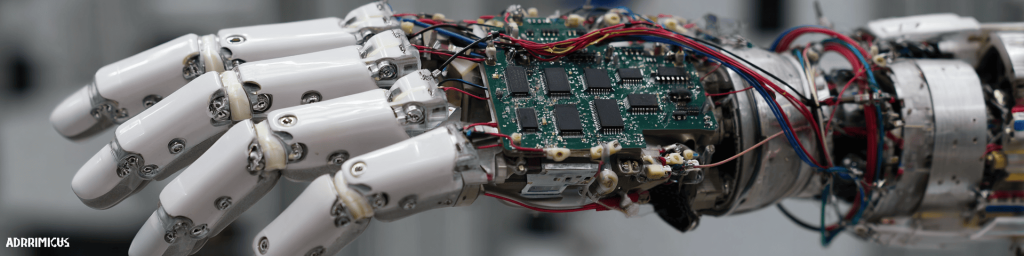
As humanoid robots transition from research labs to mass production lines, one engineering challenge stands above the rest: achieving millisecond-level coordination across dozens of finger joints. Unlike locomotion or vision—tasks increasingly handled by centralized AI accelerators—dexterous hand manipulation demands a fundamentally different compute architecture. Each finger, each joint, each tendon-driven actuator requires its own real-time control loop, running independently yet in perfect synchrony. This is where distributed edge computing chips—the “cerebellum” of the humanoid robot—become indispensable.
This article explores the convergence of edge computing, dexterous hand design, real-time operating systems (RTOS), and MCU (microcontroller unit) architectures that together enable the next generation of robotic manipulation. We examine why centralized computing falls short, how distributed MCU networks solve the latency problem, and which chip architectures and RTOS platforms are leading the way in 2025 and beyond.
Why Dexterous Hands Need Their Own “Brain”
The Latency Problem in Centralized Architectures
A typical humanoid robot hand has between 12 and 24 degrees of freedom (DoF). To grasp a fragile object—say, an egg or a glass vial—the robot must coordinate all these joints within a control cycle of 1–5 milliseconds. Any delay beyond this window leads to instability, excessive force, or dropped objects.
Traditional humanoid robots route all sensor data to a central processing unit, which then computes motor commands and sends them back. This round-trip introduces latency from data serialization, bus contention, and compute queuing. For locomotion control running at 100–200 Hz, this architecture works. For dexterous manipulation at 500–1,000 Hz per joint, it becomes a bottleneck.
As Advantech’s modular architecture white paper on humanoid robotics highlights, modern humanoid robots increasingly rely on dual-computing systems—one dedicated to AI processing and the other to real-time control—because low-latency communication between AI and control modules is essential for tasks requiring millisecond-level responsiveness.
What “Edge” Means Inside a Robot
In the context of a humanoid robot, “edge computing” does not refer to a server at the network perimeter. Instead, it means pushing compute power directly to the actuator level—embedding small, dedicated processors in or near each joint module. Each MCU runs its own closed-loop controller for position, velocity, and torque, communicating with neighboring nodes over deterministic, low-latency buses like EtherCAT, SPI, or CAN-FD.
This is a paradigm shift from centralized brains to distributed intelligence. As noted by RoboticsTomorrow, “for scalable, responsive robots operating in dynamic environments, the future is unmistakably at the edge. Distributed intelligence is becoming the foundation for agile, efficient, and mission-ready robots.”
How Distributed Edge MCUs Power a Dexterous Hand
Architecture: Master-Slave MCU Networks
The most common architecture for dexterous hand control uses a master-slave MCU topology:
- Master MCU: A high-performance microcontroller (e.g., HPMicro HPM6E00, STM32H7, or NXP i.MX RT1170) that receives high-level grasp commands from the central AI unit and decomposes them into per-joint trajectories.
- Slave MCUs: Smaller, dedicated controllers (e.g., HPMicro HPM5300, STM32G4, or TI TMS320F28) embedded in each finger module. Each slave runs a current loop and position loop at 10–50 kHz, ensuring microsecond-level torque regulation.
HPMicro demonstrated exactly this architecture at NEPCON China 2025, showcasing a dexterous hand demo using an HPM6E00 master and HPM5300 slave setup. The system leverages high-speed SPI and EtherCAT for microsecond-level multi-joint control, with on-chip current loop processing that eliminates external analog circuitry.
Why MCUs Over Application Processors?
One might ask: why not use a more powerful application processor (e.g., an ARM Cortex-A class SoC) for each finger? The answer lies in three constraints:
- Deterministic timing: MCUs running bare-metal code or a hard RTOS can guarantee sub-microsecond jitter in control loops. Application processors running Linux cannot.
- Power and thermal envelope: Each finger module has a thermal budget measured in milliwatts. An MCU consuming 50–200 mW fits; an SoC consuming 2–5 W does not.
- Cost at scale: With humanoid robots entering mass production, every dollar counts. A dedicated MCU at $1–$5 per joint is economically viable; an SoC at $20–$50 is not.
GigaDevice, one of China’s leading MCU manufacturers, has explicitly positioned its chip portfolio for the humanoid robot wave. The company focuses on real-time servo control, a complete analog product portfolio, and high-performance storage products to support scaled applications for humanoid robots entering large-scale production in 2025.
The Role of Real-Time Operating Systems (RTOS)
Why RTOS Matters for Hand Control
A real-time operating system ensures that critical tasks—reading a force sensor, computing a PID update, sending a PWM command—execute within bounded, predictable time. In dexterous hand control, missing a single deadline can mean crushing an object or losing grasp stability.
The key RTOS metrics for robotic hand control include:
- Interrupt latency: Time from hardware interrupt to ISR execution. Target: < 1 µs.
- Context switch time: Time to swap between tasks. Target: < 5 µs.
- Jitter: Variation in periodic task execution. Target: < 10 µs for 1 kHz loops.
Leading RTOS Options for Robotic MCUs
| RTOS | Typical MCU Targets | Key Strengths for Robotics |
|---|---|---|
| FreeRTOS | STM32, ESP32, NXP | Widespread adoption, AWS IoT integration, zero-cost |
| Zephyr | Nordic, NXP, STM32 | Modern architecture, native networking, strong community |
| RT-Thread | GigaDevice, HPMicro, RISC-V | Growing ecosystem in China, lightweight, modular |
| ThreadX (Azure RTOS) | STM32, Renesas | Safety certifications (IEC 61508), deterministic scheduling |
| VxWorks | High-end ARM, x86 | Industrial-grade, DO-178C / IEC 62443 certified |
| µC/OS-III | Broad MCU support | Deterministic, well-documented, safety pre-certified |
For Chinese humanoid robot manufacturers—including Unitree, Agibot, and Fourier Intelligence—RT-Thread has emerged as a popular choice due to its native support for domestic RISC-V MCUs and its lightweight, modular kernel that allows developers to strip the OS down to exactly the components needed for motor control.
RTOS vs. Bare-Metal: A Practical Trade-off
Some dexterous hand designs forgo an RTOS entirely, running bare-metal firmware on each slave MCU to minimize overhead. The master MCU, which handles coordination and communication, then runs an RTOS to manage task scheduling. This hybrid approach delivers the best of both worlds: deterministic inner loops on slaves and flexible task management on the master.
What Makes a Good Edge Chip for Dexterous Hands?
Key Specifications to Evaluate
When selecting an MCU for dexterous hand control, engineers evaluate the following:
- PWM resolution and channels: At least 6–12 high-resolution PWM outputs for motor drive, with dead-time insertion and complementary output support.
- ADC speed and accuracy: 12–16-bit ADCs sampling at ≥ 1 MSPS for current sensing. Simultaneous sampling across channels is critical for three-phase motor control.
- Communication peripherals: High-speed SPI (≥ 50 MHz), CAN-FD, or EtherCAT slave controllers for deterministic inter-node communication.
- On-chip DSP / FPU: Hardware floating-point and DSP instructions for real-time PID, FOC (field-oriented control), and trajectory interpolation.
- Functional safety: IEC 61508 SIL-2 or ISO 13849 PL-d compliance for collaborative robot applications.
Chip Families Gaining Traction in 2025
HPMicro HPM6E00 / HPM5300 Series
Developed in China, these RISC-V-based MCUs target motor control and industrial automation. The HPM6E00 runs at up to 600 MHz with dual-core RISC-V, integrated EtherCAT, and on-chip analog comparators for sensorless FOC. HPMicro’s single-chip servo solution is gaining adoption in humanoid robot joint modules.
GigaDevice GD32 Series
GigaDevice’s ARM Cortex-M and RISC-V MCU portfolio covers the full range from low-cost finger controllers to high-performance master processors. The company’s focus on humanoid robot applications—with dedicated evaluation kits for servo control—positions it as a key supplier for mass-production humanoid hands.
STMicroelectronics STM32G4 / STM32H7
The STM32G4 line, with its hardware math accelerators (CORDIC, FMAC) and high-resolution timers, is a proven choice for BLDC and PMSM motor control in robotic joints. The STM32H7, running at 480 MHz with dual cores, serves as a master controller for multi-finger coordination.
Renesas RA / RZ Series
Renesas has published reference designs specifically for dexterous hand control, featuring pneumatic and electric actuation systems with integrated sensing. Their RA series MCUs offer TrustZone security and real-time motor control peripherals.
NXP i.MX RT Crossover Series
Blurring the line between MCU and application processor, the i.MX RT1170 runs at 1 GHz with real-time capabilities, making it suitable for master-level coordination tasks that require both speed and determinism.
Communication Protocols: The Nervous System
How Finger Joints Talk to Each Other
The communication bus connecting distributed MCUs is just as critical as the MCUs themselves. The protocol must deliver:
- Deterministic latency: Every packet arrives within a known time window.
- High bandwidth: Enough to carry position, velocity, current, and force data from all joints every millisecond.
- Low wiring overhead: A dexterous hand has very limited space for cabling.
| Protocol | Cycle Time | Bandwidth | Wiring | Adoption in Robotics |
|---|---|---|---|---|
| EtherCAT | 62.5 µs – 1 ms | 100 Mbps | Single twisted pair | High (industrial + humanoid) |
| CAN-FD | ~1 ms | 8 Mbps | Twisted pair | High (automotive + joints) |
| High-speed SPI | < 10 µs | 50+ Mbps | 4-wire + CS | Medium (intra-hand) |
| RS-485 / Modbus | ~5 ms | 10 Mbps | Twisted pair | Low (legacy) |
| MIPI I3C | < 100 µs | 12.5 Mbps | 2-wire | Emerging (sensor hubs) |
EtherCAT has become the de facto standard for humanoid robot joint communication due to its sub-millisecond cycle times and daisy-chain topology, which minimizes wiring. ASIX Electronics, a specialist in embedded networking, has identified EtherCAT as the best communication solution for humanoid robots and dexterous hands in smart manufacturing scenarios.
From Lab to Factory Floor: The Mass Production Challenge
Scaling Distributed Edge Compute
As humanoid robots enter mass production—with companies like Figure AI, Tesla (Optimus), Unitree, and Agibot targeting thousands of units per year—the distributed edge computing architecture must be:
- Cost-optimized: Bill-of-materials (BOM) for a 5-finger hand’s electronics should stay below $50–$100.
- Testable: Each MCU node must support in-circuit testing and firmware-over-the-air (FOTA) updates.
- Thermally robust: Operating in confined spaces with ambient temperatures up to 60°C.
- Supply-chain resilient: Multi-source MCU options to avoid single-vendor lock-in.
The year 2025 is widely considered a pivotal year for humanoid robots moving toward large-scale production, driving significant growth in demand for high-precision motor control, multimodal sensing, and edge computing chips.
The Software Stack Challenge
Hardware is only half the story. The software running on these distributed MCUs must support:
- Standardized motor control libraries: FOC, trapezoidal, and sinusoidal drive algorithms.
- Robot middleware integration: ROS 2 micro-ROS nodes that bridge the RTOS world with the larger robot software ecosystem.
- Over-the-air updates: Secure bootloaders and differential firmware updates for field-deployed robots.
- Digital twin synchronization: Real-time telemetry streaming to simulation environments for continuous learning and diagnostics.
What Lies Ahead: AI at the Fingertip
On-Chip Neural Inference
The next frontier is embedding tiny neural networks directly on finger-level MCUs. These models—running at 8-bit integer precision on dedicated NPU cores—can:
- Predict slip before it happens, using tactile sensor data.
- Adapt grasp force in real time based on learned material properties.
- Detect anomalies such as joint wear or sensor drift.
NVIDIA’s Jetson Thor platform, unveiled at CES 2026, represents the high end of this vision—bringing transformer-class inference to the robot body. But for individual finger joints, the future lies in ultra-lightweight models running on sub-1-watt MCUs, a space where RISC-V architectures with vector extensions (RVV) show particular promise.
The Convergence of Edge AI and Robotic Dexterity
A modern robotic hand can already process tactile feedback and adjust grip force in under 5 milliseconds—far faster than the approximately 150 milliseconds a human requires. As edge AI models become more capable and MCU architectures add dedicated inference accelerators, we can expect dexterous hands to achieve manipulation skills that surpass human performance in speed, precision, and consistency.
The distributed edge computing chip is not merely a support component—it is the enabler that transforms a mechanical appendage into an intelligent, adaptive hand. It is, in every sense, the cerebellum of the humanoid robot.
Frequently Asked Questions
What is edge computing in the context of humanoid robots?
Edge computing in humanoid robots refers to embedding dedicated processors—typically MCUs—directly at or near each actuator and sensor, enabling real-time, low-latency control without relying on a central processor or cloud connection.
Why can’t a single powerful chip control a dexterous robotic hand?
A dexterous hand requires 500–1,000 Hz control loops per joint with sub-microsecond jitter. A single centralized processor introduces bus latency, scheduling conflicts, and thermal constraints that make this infeasible. Distributed MCUs solve this by running independent, deterministic control loops at each joint.
What is the role of RTOS in robotic hand control?
An RTOS ensures that time-critical tasks—sensor reading, control computation, motor command output—execute within guaranteed time bounds. This determinism is essential for stable, safe manipulation in dexterous hand applications.
Which MCUs are commonly used in humanoid robot hands?
Popular choices include HPMicro HPM6E00/HPM5300 (RISC-V), GigaDevice GD32 series, STMicroelectronics STM32G4/H7, Renesas RA series, and NXP i.MX RT crossover processors. Selection depends on cost, performance, peripheral requirements, and supply chain considerations.
How do distributed MCUs communicate inside a robotic hand?
Common protocols include EtherCAT (for sub-millisecond deterministic communication), CAN-FD (for robust joint-level messaging), and high-speed SPI (for ultra-low-latency intra-hand data transfer).
发表回复
要发表评论,您必须先登录。