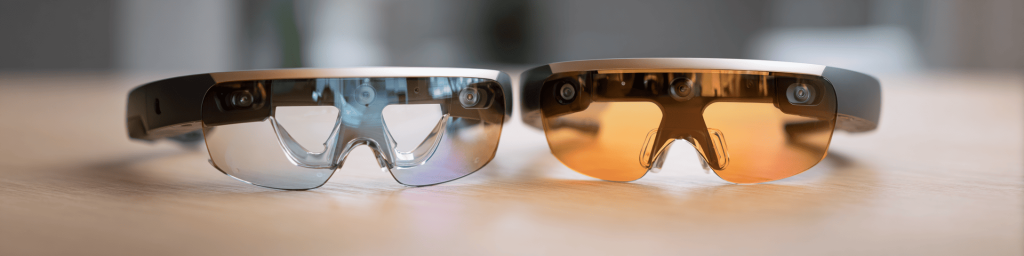
All-day wearable augmented reality (AR) glasses are now constrained less by optics and more by the microdisplay light engine, especially the driver IC architecture. MicroLED microdisplays can deliver the extreme peak brightness needed for outdoor AR in a tiny package, but commercial success depends on driving schemes that raise pixel efficiency while keeping heat low enough for comfortable wear.
This article examines how MicroLED AR driving solutions balance in-eye brightness with thermal limits, using publicly discussed industry benchmarks and established design principles.
The Brightness Imperative: Why AR Glasses Need Very High Panel Brightness
What does “in-eye brightness” mean?
AR images pass through waveguides and combiners before reaching the eye, so panel luminance is not the same as retinal luminance. Optical coupling, coatings, and pupil replication can impose large losses, which is why AR systems often require panel-level brightness far above typical consumer displays to remain readable outdoors.
How bright are current MicroLED microdisplays?
Recent public announcements commonly cite panel-level peak brightness in the hundreds of thousands to around one million nits for MicroLED microdisplays, reinforcing a key point: the limiting factor is shifting from raw luminance to efficient, thermally safe driving.
MicroLED Pixel Efficiency: Why the Driver Matters
The efficiency gap across colors
At very small pixel sizes, efficiency differs strongly by wavelength, and the least efficient channel can dominate total power and heat. Driver strategies must therefore support color-dependent current control and calibration.
Full color options and driver implications
- Quantum-dot color conversion simplifies the emitter array but adds conversion loss and thermal sensitivity.
- Native RGB approaches require tighter per-color drive control and uniformity correction.
In both cases, the driver IC largely determines how much electrical power becomes useful in-eye luminance.
Driver IC Architecture: Trading Brightness, Grayscale, and Heat
What a MicroLED driver IC must do
A MicroLED microdisplay driver IC typically handles:
- Current regulation for luminance control.
- Grayscale modulation using PWM, PAM, or a hybrid method.
- Scan-line multiplexing to reduce interconnect complexity.
- Calibration and compensation for pixel non-uniformity.
- Thermal sensing and protection via on-die monitoring and feedback.
PWM vs. PAM (and why hybrid approaches are attractive)
- PWM keeps LEDs near a stable operating point but concentrates instantaneous heat during pulses.
- PAM spreads power more continuously but can complicate low-level color stability and circuit design.
Hybrid PWM + PAM schemes can reduce peak current for typical content while preserving fine grayscale control.
Frame rate, scan rate, and duty cycle
Higher refresh and lower latency reduce visible artifacts, but shorter per-line on-times can force higher instantaneous currents for the same average luminance. Banked or parallel-refresh architectures can increase effective duty cycle and ease thermal stress.
Thermal Management: A Light-Engine Problem, Not Just a Materials Problem
Where heat is generated
Heat comes from the emitter junctions, the CMOS backplane and driver circuitry, and optical losses that become absorbed energy.
Why passive solutions dominate
Glasses-scale form factors typically favor passive conduction and spreading through:
- Thermally efficient packaging and interconnects.
- High-conductivity attach materials and heat paths into the frame.
- System-level spreading using the temple structure as a sink.
Closed-loop thermal control in the driver
Driver ICs can improve comfort and reliability through:
- Continuous temperature sensing.
- Adaptive brightness scaling near limits.
- Content-aware power budgeting.
- Temporal techniques that smooth power delivery.
Industry Approaches and What They Signal
Leading MicroLED microdisplay suppliers and research groups increasingly emphasize co-optimization of the MicroLED array, the CMOS backplane, and the driving method. The recurring theme across public roadmaps is consistent: once panel brightness reaches the required range, driver efficiency and thermal control become the differentiators.
Market Outlook: Why this becomes urgent by 2026
If lightweight AR is to scale, the microdisplay subsystem must deliver outdoor-readable brightness while fitting strict power and temperature budgets. That places the burden on the driver IC and system-level power management as much as on the emitters themselves.
FAQ
Why is MicroLED favored for outdoor AR?
Because AR optics can impose large losses, systems often need exceptionally high panel brightness. MicroLED is widely discussed as a strong candidate for meeting these requirements in compact light engines.
Why does the driver IC matter so much?
The driver determines peak current, duty cycle, uniformity correction, and thermal feedback, all of which control how much of the electrical input becomes usable in-eye brightness without overheating.
Conclusion
MicroLED can meet AR’s brightness demands, but all-day wearability depends on driver IC architectures that maximize pixel efficiency while actively managing thermal limits. The most effective solutions combine efficient modulation, parallelized drive architectures, and closed-loop temperature-aware power control.
发表回复
要发表评论,您必须先登录。